

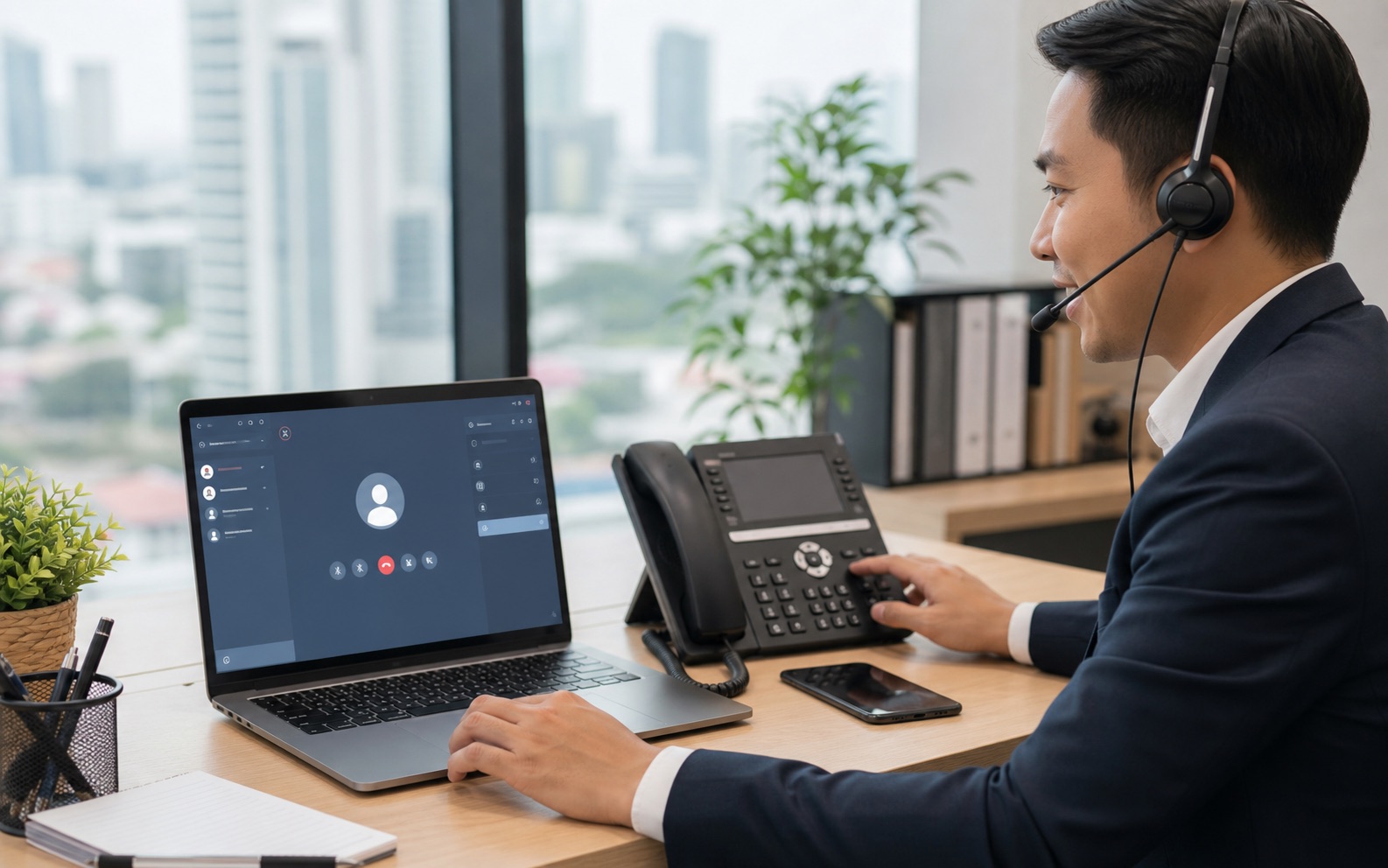
For decades, business phone lines in Malaysia meant copper wires, a box on the wall, and a bill that arrived whether you used the line or not. That era is ending. More Malaysian businesses — from two-person startups in Bangsar to multi-branch operations across the country — are moving their calls onto the internet with business VoIP. If you’ve heard the term but aren’t quite sure what it means or whether it’s right for you, this guide is for you.
What is business VoIP, in plain language?
VoIP stands for Voice over Internet Protocol. Instead of carrying your calls over traditional copper phone lines, VoIP turns your voice into data and sends it over your internet connection. To the person on the other end, it sounds like a normal phone call — often clearer. To your business, it behaves like a phone system with superpowers: it works on desk phones, laptops and mobiles, and it’s managed through software rather than hardware.
The practical upshot is that your “phone system” stops being a physical box you have to maintain and becomes a service you simply use — one that scales up or down as your team does.
Why Malaysian businesses are switching
The move to business VoIP isn’t about chasing technology for its own sake. It’s driven by three very practical pressures.
Lower, more predictable costs
VoIP removes the cost of dedicated phone lines and on-site hardware. Calls between your own offices and staff are typically free, and external rates are lower — especially for businesses that make a lot of outbound or international calls. Just as importantly, costs become predictable: you pay per user, per month, instead of being surprised by line rentals and call charges.
Flexibility and remote work
Hybrid and remote work are now normal. With VoIP, an employee’s business number follows them — they can take a call on their laptop at home, their mobile in transit, or a desk phone in the office, all on the same extension. New hires get a number in minutes, not days.
Features that used to cost a fortune
Auto-attendants, call queues, voicemail-to-email, call recording and analytics were once enterprise-only luxuries. With VoIP they’re standard, which means a small Malaysian business can present itself as professionally as a large one.
The features to expect
A capable business VoIP service should include:
- HD voice — clearer-than-landline audio quality.
- Softphones and mobile apps — make and take business calls from any device.
- IVR / auto-attendant — “press 1 for sales” menus that route callers automatically.
- Call recording — for training, quality and compliance.
- Voicemail-to-email — never miss a message.
- Number porting — keep the business numbers your customers already know.
If you run outbound campaigns or a support desk, look for a system that connects neatly to a dialer or contact-centre tools so your phone system and your customer conversations live in one place.
What does business VoIP cost in Malaysia?
Most business VoIP in Malaysia is priced per user, per month, which makes budgeting simple: ten staff means ten seats. Compared with traditional lines, you save on line rental, hardware, and inter-office call charges, and you avoid large upfront capital costs. For a clear picture of plans and what’s included, our pricing page lays it out without the fine-print games.
A useful way to think about it: traditional phone lines are a fixed cost you pay regardless of value; VoIP is an operating cost that scales with your actual size and usage.
Will call quality hold up?
This is the question every cautious business owner asks, and it’s a fair one. VoIP quality depends on your internet connection — but with the broadband available across most of Malaysia today, that’s rarely a barrier. A few practical points:
- A stable connection matters more than raw speed; voice uses very little bandwidth.
- Quality of Service (QoS) settings on your router prioritise voice traffic so calls stay crisp even when the network is busy.
- A reputable provider will assess your setup before you go live and flag anything that needs attention.
Done properly, most businesses find VoIP calls sound better than the landlines they replaced.
Migrating without disruption
The fear of “switching everything over” keeps many businesses on outdated systems longer than they should be. In practice, a good migration is undramatic:
- Port your numbers so customers never notice a change.
- Run in parallel for a short period if you want a safety net.
- Train your team — the apps are intuitive, so this is usually quick.
- Lean on local support to handle the technical details.
The right partner does the heavy lifting and schedules the cutover around your business, not the other way around.
Three myths worth clearing up
“VoIP isn’t reliable enough for business”
This was a fair concern fifteen years ago. Today, with business-grade broadband and providers running redundant, monitored infrastructure, VoIP is at least as reliable as traditional lines — and often more so, because the system isn’t tied to a single fragile box in your office.
“We’ll lose our phone numbers”
You won’t. Number porting lets you bring your existing business numbers with you, so customers dial the same numbers they always have. A good provider manages the port for you and times it to avoid any gap in service.
“It’s complicated to manage”
The opposite is usually true. Instead of calling out a technician to add an extension or change a menu, you make the change yourself in a web dashboard in seconds — or ask your provider’s support team to do it for you.
Is business VoIP right for you?
If your business is growing, hiring, opening new locations, supporting remote staff, or simply tired of unpredictable phone bills and ageing hardware, VoIP almost certainly makes sense. The technology is mature, the cost case is strong, and the flexibility is hard to give up once you have it.
If you’d like to see how it would work for your specific setup, talk to the MYITG team for a free recommendation — or read our companion guide on cloud PBX to understand the smart phone system that sits behind modern business VoIP.